Retrieval Practice Lesson Plan: Template + 10 Classroom Examples
A complete retrieval practice lesson plan template plus 10 classroom-tested examples for primary and secondary teachers.

A good retrieval practice lesson plan does one thing well: it makes students pull information out of their heads, repeatedly, without the crutch of notes. The cognitive science behind it is settled — retrieval strengthens memory better than re-reading or highlighting. The problem for teachers is operational: how do you build a retrieval practice lesson in under an hour, with aligned assessments, and run it without turning every class into a pop quiz? This guide gives you a working template and 10 examples you can adapt for tomorrow's lesson.
What retrieval practice actually is
Retrieval practice is the act of recalling information from memory, as opposed to re-encountering it. Dunlosky et al.'s 2013 review in Psychological Science in the Public Interest evaluated ten learning techniques across hundreds of studies and rated practice testing and distributed practice as the two highest-utility techniques. The Learning Scientists and the EEF's Teaching and Learning Toolkit keep the same finding at the top of their strategy rankings.
Three things separate retrieval practice from ordinary quizzing:
- Low stakes. Students recall without grade pressure. The goal is strengthening memory, not measuring it.
- Spaced over time. A topic is retrieved days and weeks later, not only at the end of a unit.
- Aligned with learning objectives. The retrieval prompts target the specific knowledge you want durable, not trivia.
A reusable retrieval practice lesson plan template
Use the structure below for a single 50–60 minute lesson. It works for primary and secondary classrooms with minor pacing changes.
1. Warm-up: brain dump (5 minutes)
Students write everything they remember about the last lesson's topic on a blank sheet. No notes, no books. Collect or photograph for your own reference — you are not grading it.
2. Retrieval grid (8–10 minutes)
Project a 3×3 grid with 9 questions covering:
- 3 questions from last lesson
- 3 questions from last week
- 3 questions from the start of the unit
Students answer individually for 5 minutes, then pair-check for 3 minutes. You reveal the answers last.
3. New-material teaching (20–25 minutes)
Whatever method fits the new content — explicit instruction, worked examples, or guided practice. The retrieval phase is the opener, not the whole lesson.
4. Applied retrieval (8–10 minutes)
Students apply the new content to a short task that forces them to retrieve the prior knowledge from steps 1 and 2. This is the "transfer" slot — where retrieval compounds with the new learning.
5. Exit ticket (5 minutes)
Three questions: one from today, one from last week, one from earlier in the term. Collect, scan, and adjust next lesson's retrieval grid based on what the class forgot.
10 retrieval practice lesson plan examples
1. Brain dump (any subject, any age)
Two minutes, blank paper, "write everything you remember about X." Fastest win in teaching — zero prep, works from primary through A-level.
2. 3-2-1 recall
Students write 3 facts, 2 concepts, and 1 question from the previous lesson. The question slot surfaces confusion without anyone having to raise a hand.
3. Flashcard speed rounds
Three minutes of paired flashcards at the start of class. Partner asks, student answers, switch. Pre-made sets cut prep to zero.
4. Retrieval grid (as above)
The 9-question grid spanning three time horizons. Pairs well with a weekly rhythm.
5. Mini-whiteboard chorus
Teacher asks a question; every student writes the answer on a mini whiteboard and holds it up. Immediate formative feedback plus retrieval in one step.
6. Think-pair-share on a closed book
A discussion prompt that cannot be answered from the textbook. Students think solo for 60 seconds, pair for 90, then share. Retrieval disguised as conversation.
7. Two-column cloze
Give students a paragraph with key terms blanked out. They fill it in from memory. Useful for vocabulary-heavy subjects (science, history, languages).
8. Last-lesson-first warm-up
Open the new lesson with three questions about the previous one, answered silently in 90 seconds. Short, ritualised, low-friction.
9. Past-paper corner
Five minutes on one exam-style question at the end of class. For older year groups, the retrieval-plus-application loop builds exam stamina alongside memory.
10. Live quiz with anonymity
A low-stakes digital quiz where answers are visible to the teacher but not to other students. Removes the social cost of getting one wrong and keeps the retrieval itself honest.
Common mistakes when building a retrieval practice lesson plan
Three traps that show up often:
- Retrieval becomes a grade. The second you grade it, students revert to cramming. Keep it low stakes.
- No spacing. Retrieving yesterday's lesson is useful. Retrieving last month's is where the compounding happens. Rotate older content in deliberately.
- Prompts that test recognition, not recall. Multiple choice still works but free recall produces stronger memory. Mix both; do not default to only the easy format.
How long until retrieval practice starts working?
Roediger and Karpicke's 2006 Psychological Science paper showed the testing effect at one-week and one-month retention intervals — the memory advantage widens over time, not within a single session. Classroom reports converge on roughly three to four weeks of consistent use before the class notices the effect — stronger recall at the end of the unit, fewer "we did that?" moments. If you stop after one lesson and conclude it does not work, you stopped too early.
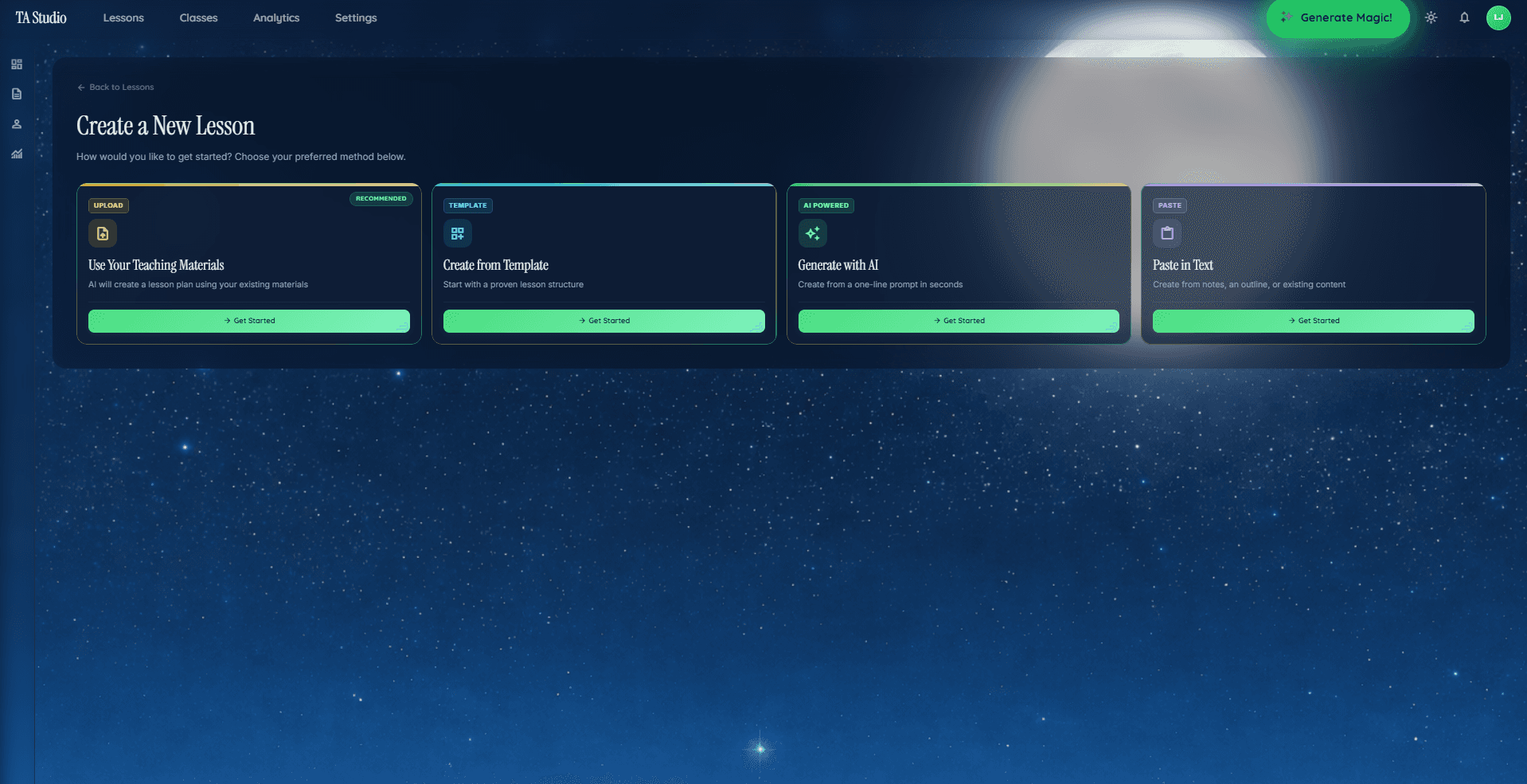
Building a retrieval practice lesson plan in TAyumira
TAyumira treats retrieval practice as a first-class teaching method. When you pick it as the method for a lesson, the generator produces:
- A retrieval warm-up slide with questions spanning your previous lessons
- The main teaching segment aligned to your learning objective
- An applied retrieval task that connects old and new
- An exit ticket that rotates questions across time horizons
- A live interactive presenter you can run the lesson from — with student quizzes and confusion flags built in
The result is a retrieval practice lesson plan that takes 2–5 minutes to generate, follows the structure above, and exports cleanly to .pptx, .docx, or PDF if you prefer to run from slides you already know. Try it free.
FAQ
What is a retrieval practice lesson plan?
A retrieval practice lesson plan is a lesson structured around short, repeated, low-stakes recall tasks rather than re-reading or passive review. Students pull information out of memory at the start of the lesson, during an applied task, and on an exit ticket — typically with content spanning yesterday, last week, and earlier in the term.
How often should you use retrieval practice in class?
Most evidence points to short, daily retrieval (2–10 minutes) as the highest-return frequency. A full retrieval-practice-led lesson once a week, combined with daily openers, gives you spacing without eating instruction time. Less than once a week and the spacing effect weakens.
What is the difference between retrieval practice and testing?
Retrieval practice is low-stakes recall designed to strengthen memory. Testing is measurement — scored, summative, and used for grades. The two use similar mechanics but serve different goals. Grading retrieval practice turns it back into a test and undoes most of the benefit.
Does retrieval practice work for primary school students?
Yes. Primary classrooms use shorter retrieval windows (1–3 minutes), more visual prompts, and more paired retrieval. The same evidence base applies. Simple formats like brain dumps and mini-whiteboard rounds work from around Year 2 upward with minimal adaptation.
Can AI help me build retrieval practice lessons?
Yes, if the tool supports retrieval practice as a named method. A generic chatbot will produce a retrieval-flavoured lesson only if you prompt it precisely. A dedicated AI lesson planner like TAyumira treats retrieval practice as a first-class option and follows the structure automatically — opener, applied task, rotated exit ticket.
Ready to use
Save the template above, pick three of the 10 examples that fit your next unit, and run them for the next three weeks. If you want the whole plan built for you, generate a retrieval practice lesson in TAyumira — free tier covers the full workflow.