Mastery Learning: A Teacher's Guide to Getting Every Student There
A practical mastery learning guide — what it is, when it works, a reusable lesson plan, and the management decisions that make it sustainable.
Mastery learning is the teaching method that keeps teachers awake at 11pm marking. It works — Bloom's 1984 "2 Sigma Problem" paper set up the modern evidence base and four decades of follow-up has held it up. The EEF's Mastery Learning entry puts the average effect at +5 months across 80 studies, with an honest caveat that mastery learning is "challenging to implement effectively." The question is never whether mastery learning raises attainment; the question is whether it is sustainable for a working teacher with 150 students and one planning period. This guide is a grounded walk through what mastery learning is, when it works, a reusable lesson plan, and the management decisions that make it survivable.
What mastery learning is
Mastery learning is a teaching approach where students must demonstrate proficiency on a specific learning objective before moving to the next. Lessons are sequenced so later content depends on earlier mastery. Students who need more time get more time; students who master quickly move to extension work.
The two non-negotiables:
- A specific, observable mastery criterion — "can solve a one-step linear equation with 80% accuracy across five problems," not "understands equations."
- A corrective loop — students who do not meet the criterion get targeted re-teaching plus another assessment, not a failing grade.
Without both, mastery learning collapses back into traditional pacing with different labels.
The reusable mastery learning lesson plan
1. Objective and mastery criterion (3 min)
Display both. "By the end, you will be able to [specific observable skill] at [threshold]." Students know what "done" looks like.
2. Teaching (15–20 min)
Explicit instruction usually works best for the initial teach. Worked examples, checks for understanding at every step, guided practice.
3. Formative check (5 min)
Short quiz aligned to the mastery criterion. Mini-whiteboard rounds, digital quiz, or paper check.
4. Branching (15–20 min)
Students who met the criterion move to extension (deeper problems, applied transfer). Students who did not split into a small group with the teacher for targeted re-teaching using a different example.
5. Second check (5 min)
The re-taught group takes a parallel assessment. Same criterion, different questions. Most students clear it on round two.
6. Cool-down exit ticket (3–5 min)
Everyone. Captures who is still below threshold for the next lesson's opener.
When mastery learning works — and when it is the wrong call
When it works
- The content has a clear, observable mastery criterion (most of maths, much of science, phonics, early reading, procedural skills).
- The sequence genuinely depends on earlier mastery — jumping ahead without it causes real problems later.
- Class sizes and time allow for the branching step. Primary and early secondary fit best.
When it is the wrong call
- Content is open-ended — essays, discussion, creative work. "Mastery" is harder to define.
- Timetable is unforgiving and the sequence is fixed (some exam boards). Mastery means variable pacing; a fixed scheme of work rarely allows it in practice.
- One-off lesson that does not build on anything. Mastery learning only compounds when sequence matters.
The sustainability problem (and how to solve it)
The main reason mastery learning gets abandoned is the corrective loop. If every student who does not meet the criterion needs an individualised re-teach, one teacher cannot do it at scale. Three moves that make it survivable:
- Pre-build the corrective resources. A short video per main misconception, or a worked-example card pack. Built once, reused every year.
- Use peer re-teaching. Students who mastered it pair with students who did not. Works if the pairs are thoughtful — not the same pair every time, and not the strongest with the weakest (too big a gap).
- Accept that not every lesson needs branching. Use the full mastery loop on the 3–5 most pivotal skills in a term. For the rest, a single check-and-move is fine.
Mastery grading: a practical compromise
Full mastery grading (students keep re-attempting until they pass, grade book reflects current mastery) is the most faithful implementation but requires departmental buy-in. A practical compromise:
- Grade summative assessments once.
- Track mastery separately on a simple rubric (not mastered / approaching / mastered).
- Update the rubric after each assessment. Parents see the grade; teacher plans off the rubric.
This is less pure but more sustainable and still captures most of the benefit.
Common mistakes
- Vague mastery criteria. "Understands fractions" is not a criterion. "Can add fractions with unlike denominators in 4 of 5 problems" is.
- No corrective step. Marking it, returning it, moving on — that is traditional pacing with a new label.
- Same intervention for everyone below threshold. Different students got it wrong for different reasons. A blanket re-teach usually misses.
- Mastery as punishment. If "not mastered yet" is framed as failure, students hide it. Frame it as "you get another go."
How TAyumira generates a mastery learning lesson plan
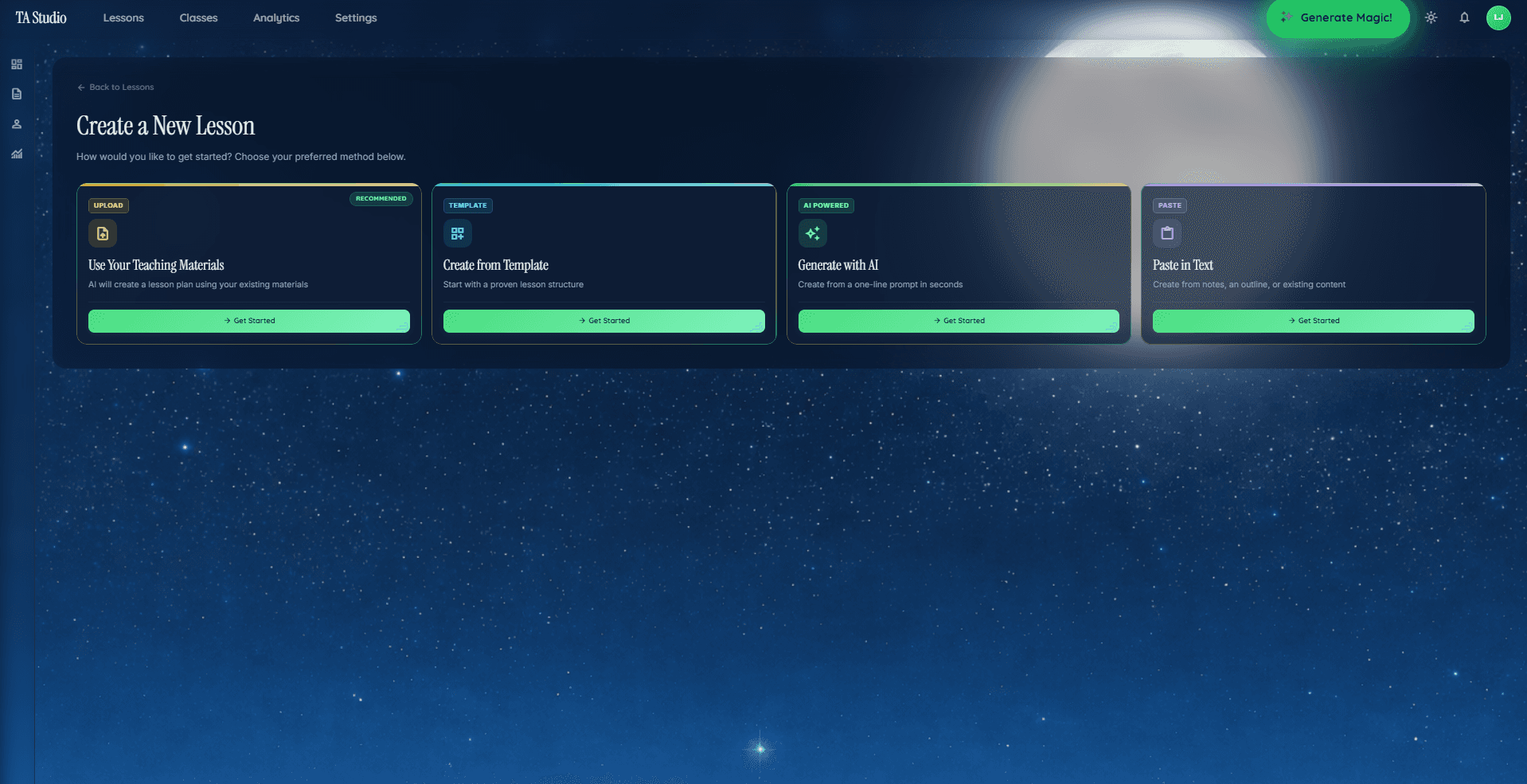
TAyumira supports mastery learning as one of ten named teaching methods. The generator produces:
- A lesson with a specific observable mastery criterion
- The initial teach using explicit instruction
- A formative check aligned to the criterion
- Branching content — extension for students who mastered, targeted re-teach materials for students who did not
- A second parallel assessment
- A cool-down exit ticket
Try it free — Free tier covers the full workflow.
FAQ
What is mastery learning?
Mastery learning is a teaching approach where students must demonstrate proficiency on a learning objective before moving to the next. A specific observable mastery criterion is set, students are assessed against it, and those who do not meet it receive targeted re-teaching and another assessment. It compounds where sequence matters, especially in maths, science, and early reading.
What is the difference between mastery learning and traditional teaching?
Traditional teaching holds time constant and lets learning vary — everyone moves on at the same pace. Mastery learning holds learning constant and lets time vary — everyone reaches the criterion but some take longer. The evidence base for mastery learning, going back to Bloom in the 1960s, shows higher attainment where it is implemented consistently.
How do you set a good mastery criterion?
The criterion must be specific, observable, and set at a real threshold. "Can factorise a quadratic with integer coefficients in 4 of 5 problems" works. "Understands quadratics" does not. Write the criterion before you write the lesson — it constrains everything else and keeps the assessment aligned.
Does mastery learning work in secondary school?
Yes, for content with clear mastery criteria — most of maths, much of science, phonics, and procedural skills. It is harder in subjects where mastery is open-ended (essay writing, discussion, creative work). The main secondary-school challenge is timetable — mastery implies variable pacing, which some schemes of work do not accommodate.
Can AI generate a mastery learning lesson plan?
Yes, if the tool produces a specific mastery criterion and the branching materials for students who do and do not meet it. A general chatbot will produce a generic plan. A dedicated AI lesson planner like TAyumira generates the criterion, the formative check, the branch materials, and the second assessment — the parts that take the longest to build from scratch.
Try it on one pivotal skill
Pick one skill in your next unit where later content depends on it. Write a specific mastery criterion. Use the lesson plan above. If you want the branching materials generated for you, start a free TAyumira account.