The Inevitable Toll: Why Teaching Is Quietly Breaking the People Who Do It
Teacher burnout in 2026 isn't a personal failing. It's a systemic toll with measurable physical and emotional symptoms. Here's what the data shows — and what to do.
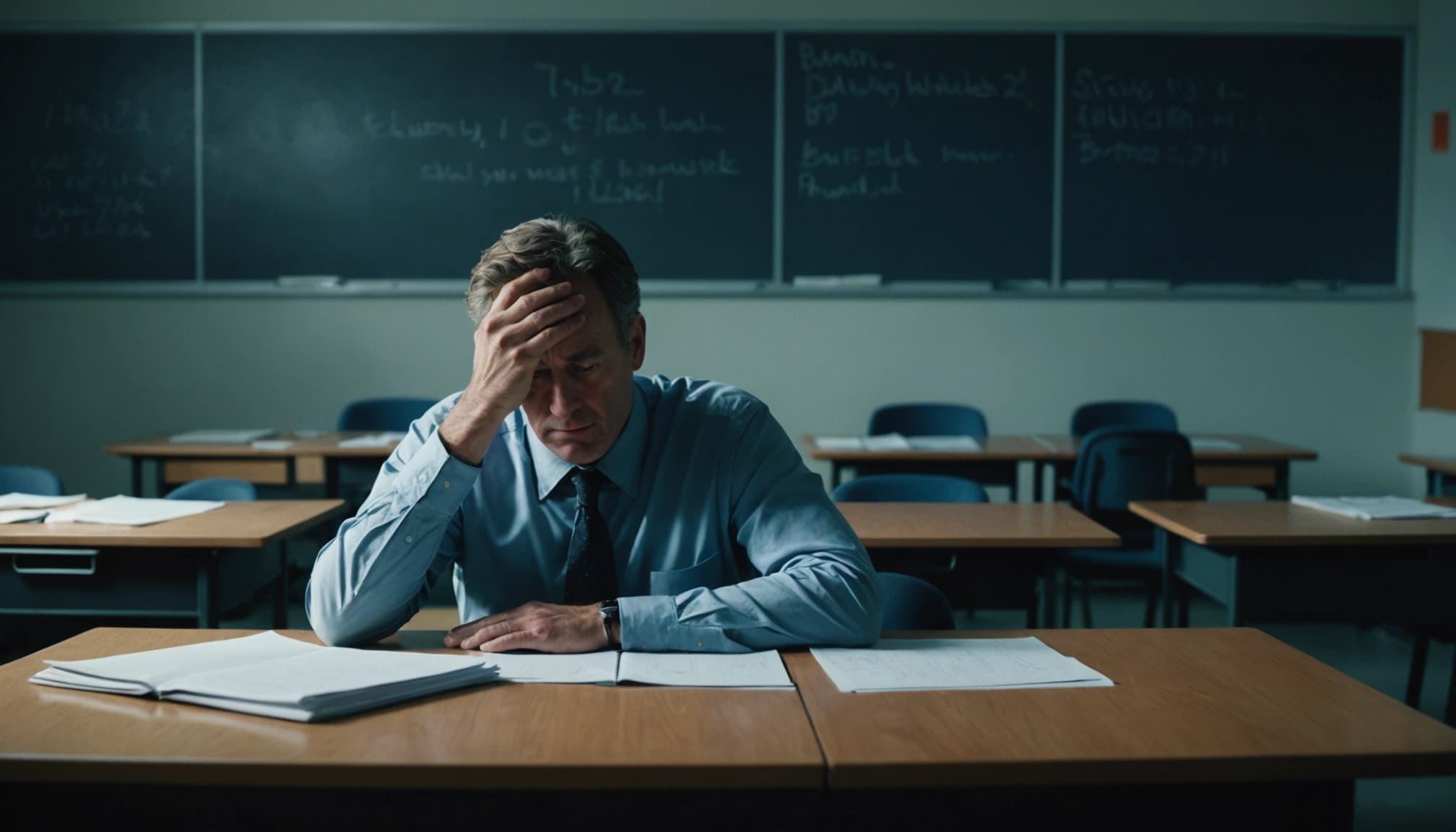
Teacher burnout is no longer a fringe wellbeing topic — it is the central, system-wide cost of how schools are being asked to operate in 2026. The UK government's Working Lives of Teachers and Leaders survey (Wave 3) reports the average teacher works 48.4 hours a week, with a third describing their workload as unmanageable. The Education Support charity's Teacher Wellbeing Index 2024 found 78% of teaching staff are stressed, 47% have considered leaving the profession, and 36% report symptoms of burnout severe enough to interfere with normal life.
This is not a soft problem. It is a measurable, predictable toll on a workforce that the country cannot replace. And almost every teacher I have spoken to in the last twelve months tells me a version of the same story — they are still in the profession, but the version of themselves they show up as on a Tuesday afternoon in March is not the one they signed up to be.
This article is not a list of self-care tips. It is an honest accounting of what the toll actually looks like, why it has become inevitable rather than exceptional, and what the realistic, individual escape routes are when the system itself is not changing fast enough.
What "burnout" actually means in clinical terms
The word burnout has been diluted into meaninglessness. People use it to mean tiredness, frustration, having a bad week. The clinical definition is more specific. The World Health Organization's ICD-11 classifies burnout as an occupational phenomenon with three dimensions:
- Emotional exhaustion — feeling depleted of emotional resources
- Depersonalisation — increased mental distance from your job, cynicism, going through the motions
- Reduced professional efficacy — a sense that you are no longer effective at the work you used to be good at
When you map those three onto a teaching career, the alignment is uncomfortable:
- Exhaustion is the 4 p.m. silence in the staffroom that nobody breaks.
- Depersonalisation is the moment you realise you cannot remember the name of the Year 9 you taught for two terms last year, and you don't really care.
- Reduced efficacy is the lesson you used to teach with confidence that now feels like reading from someone else's script.
Burnout is not stress. Stress is acute, time-bound, and resolves with rest. Burnout is structural, chronic, and rest does not fix it. That distinction matters because most school wellbeing initiatives are designed for stress, not burnout — yoga sessions, mindfulness apps, and "wellbeing Wednesdays" treat a structural injury with a paracetamol.
The five visible costs of the toll
When I tracked the symptoms teachers actually report — in conversations, in private surveys, in the NEU's annual workforce data — five clusters emerge over and over.
1. Sleep architecture collapses
The most consistent symptom is broken sleep. Not "I had a bad night" — a sustained pattern where the brain stops being able to switch off. Teachers describe waking at 3 a.m. mentally rehearsing the next day's lesson, lying awake worrying about a child, or sleeping fully through but still waking exhausted. Sleep researchers call this hyperarousal — the nervous system has lost its ability to downshift, and over months it produces measurable cognitive impairment.
2. The body sends bills the mind ignored
Teachers I know have reported migraines, IBS flares, weight changes (both directions), persistent throat infections, autoimmune flare-ups, and — in two cases — stress-induced shingles in their early thirties. The pattern is consistent with what occupational health literature describes as the somatic conversion of chronic occupational stress. Bodies present invoices the mind has been ignoring.
3. Relationships with non-teaching partners strain
This is the most under-discussed cost. Teaching marriages are statistically more likely to involve relationship strain than the general workforce, partly because the work follows you home in marking and lesson prep, partly because partners struggle to understand a job whose intensity does not visibly slow down at evenings and weekends. The 9 p.m. marking pile is a third person in the relationship.
4. Cynicism replaces idealism
This is the one teachers find hardest to admit. They became teachers because they cared. They are still in the job because they care. But somewhere between Year 2 and Year 7 of teaching, a thin layer of cynicism gets laid down — a default of expecting nothing back from leadership, students, or parents — that hardens into the professional posture by Year 10. It is a survival mechanism. It is also the early stage of depersonalisation.
5. The career off-ramp starts being researched
By the time a teacher is searching "how to leave teaching" or "tutoring jobs" at midnight on a Sunday, the toll has already done its work. The DfE's retention data shows 30% of teachers leave within the first five years. That number masks the larger group still in post but already partly out the door.
Why the toll has become inevitable, not exceptional
A useful framing is this: teacher burnout is not the result of teachers being weaker than they used to be. It is the result of the gap between what the role contractually demands and what is humanly possible widening for fifteen years.
Three structural shifts have driven that widening:
The accountability layer thickened. Performance management cycles, learning walks, deep dives, formal observations, data drops, parent-portal expectations, and SEND paperwork have each been added without anything being subtracted. A 2008 teacher and a 2026 teacher are doing partly different jobs.
Class composition got harder. Post-pandemic, the number of pupils with EHCPs has risen sharply, behaviour incidents in mainstream schools are up, and the proportion of pupils arriving below age-related expectations has grown. The cognitive load of differentiating a single lesson is higher than it was even five years ago.
The recognition gap widened. Teaching pay has fallen in real terms. School leadership turnover has accelerated. Public discourse has turned colder. The non-financial incentives that historically compensated for the workload — respect, autonomy, community standing — have all degraded.
When you stack those, you do not get a workforce that is failing. You get a workforce paying the predictable toll of a role whose demands have outrun its compensation, structural and otherwise.
Where the realistic individual escape routes are
I am suspicious of advice articles that tell exhausted teachers to "set boundaries" as if the boundary itself does the work. The boundary only holds if there is a system underneath it. So here is the honest list.
Compress the work that does not need your judgement
Roughly 40% of typical lesson planning time goes to typing, formatting, slide-building, and resource-hunting — work that does not require teacher judgement. Compressing it is the fastest individual relief. AI tools that are pedagogy-aware (rather than generic chatbots) can do that compression honestly. TAyumira's free lesson planner was built specifically because the founder hit this wall as a teacher and wanted the typing-and-formatting layer of the job removed.
Front-load the decisions
The toll is not driven by the work. It is driven by un-made decisions piling up across evenings, weekends, and the back of the mind. A 30-minute Friday-afternoon planning block — what is the arc of next week, what is the key concept for each class, what is the assessment — turns Sunday evening from dread into refinement. (See: The Sunday Night Dread Every Teacher Knows for the longer version of this argument.)
Get the body back to a baseline first
Before you tackle the structural problems of your job, tackle sleep, meals, and physical movement — in that order. If your nervous system is in chronic hyperarousal, no career-coaching framework will help. A GP appointment about chronic stress symptoms is not soft; it is operationally critical and creates a paper trail your school may need to take seriously.
Audit which parts of the job are the toll
Most teachers are surprised when they audit their week and find that 60-70% of the toll comes from a small subset of activities. Often it is one specific class, or one specific accountability process, or one specific colleague. Identifying the source narrows the conversation you need to have with your line manager from "I am drowning" to "this specific structural thing is the problem and here is what I propose."
Treat the option of leaving as a real choice, not a failure
Some teachers should leave. Some should change schools. Some should move into instructional coaching, EdTech, ITT, examining, or tutoring. Treating those moves as legitimate professional options — rather than as personal failures — is itself a form of mental hygiene. The career path that broke you is not the career you owe loyalty to.
What to take away
The inevitable toll of teaching is not a personality test you have failed. It is the predictable cost of a job whose demands have outrun the structural support around it, and the symptoms — the broken sleep, the cynicism, the body's invoices, the strained relationships, the midnight career searches — are data, not evidence of weakness.
You can chip away at the individual relief levers: compress what does not need your judgement, front-load decisions, protect the body's baseline, audit the toll, and treat leaving as a legitimate option. None of these fix the system. They buy you back enough cognitive surplus to make a real choice about what you do next.
If you are reading this on a difficult Sunday or a Wednesday lunchtime that feels longer than it should — the toll is not yours alone, it is not a sign of weakness, and there is a version of next week that is materially less heavy than this one. Start with one small piece.
FAQ: teacher burnout in 2026
Is teacher burnout a real medical condition? The World Health Organization classifies burnout as an occupational phenomenon under ICD-11. It is not a standalone medical diagnosis but is recognised as a legitimate health-affecting condition that can co-occur with anxiety and depression and can be referenced in occupational health and GP consultations.
How long does it take to recover from teacher burnout? Mild burnout caught early can resolve within weeks of structural change (workload reduction, sleep restoration, role adjustment). Severe burnout that has produced physical symptoms typically requires three to six months of sustained change, and often a period of medical or occupational health support, before the nervous system re-baselines.
Is using AI to help with lesson planning seen as cheating or unprofessional? No. Using AI to compress the typing, formatting, and resource-hunting layers of lesson planning is no more controversial than using a textbook publisher's scheme of work or a shared department drive. The professional line is around teacher judgement: the what should this class learn this week decision stays with you. Tools like TAyumira's free lesson planner compress the surrounding work without replacing the judgement.
Should I leave teaching if I am burned out? Not necessarily — but it should be on the table as a real option, not a failure. Many teachers recover by changing schools, phases, or roles rather than leaving the profession. Some discover that the right move is sideways into instructional coaching, ITT, EdTech, or tutoring. Treating "leaving" as a legitimate professional choice rather than as personal collapse is the first step.
What is the difference between teacher stress and teacher burnout? Stress is acute, time-bound, and resolves with rest. Burnout is chronic, structural, and does not resolve with rest alone — it requires changing the conditions producing it. Most school wellbeing initiatives are designed for stress and have limited effect on burnout, which is why they often feel inadequate to people experiencing the deeper version.
If lesson planning is the part of the toll that is grinding you down right now, the free TAyumira lesson planner builds research-backed lesson plans, slides, and check-for-understanding questions in minutes. No card. The point isn't the tool — it's getting one structural cost off the pile this week.