Free AI Lesson Plans: 25 Ready-to-Use Templates by Grade
25 free, editable AI-generated lesson plans across primary, middle, and high-school grade bands. Each template maps to a specific teaching method and includes objectives, activities, and exit tickets.
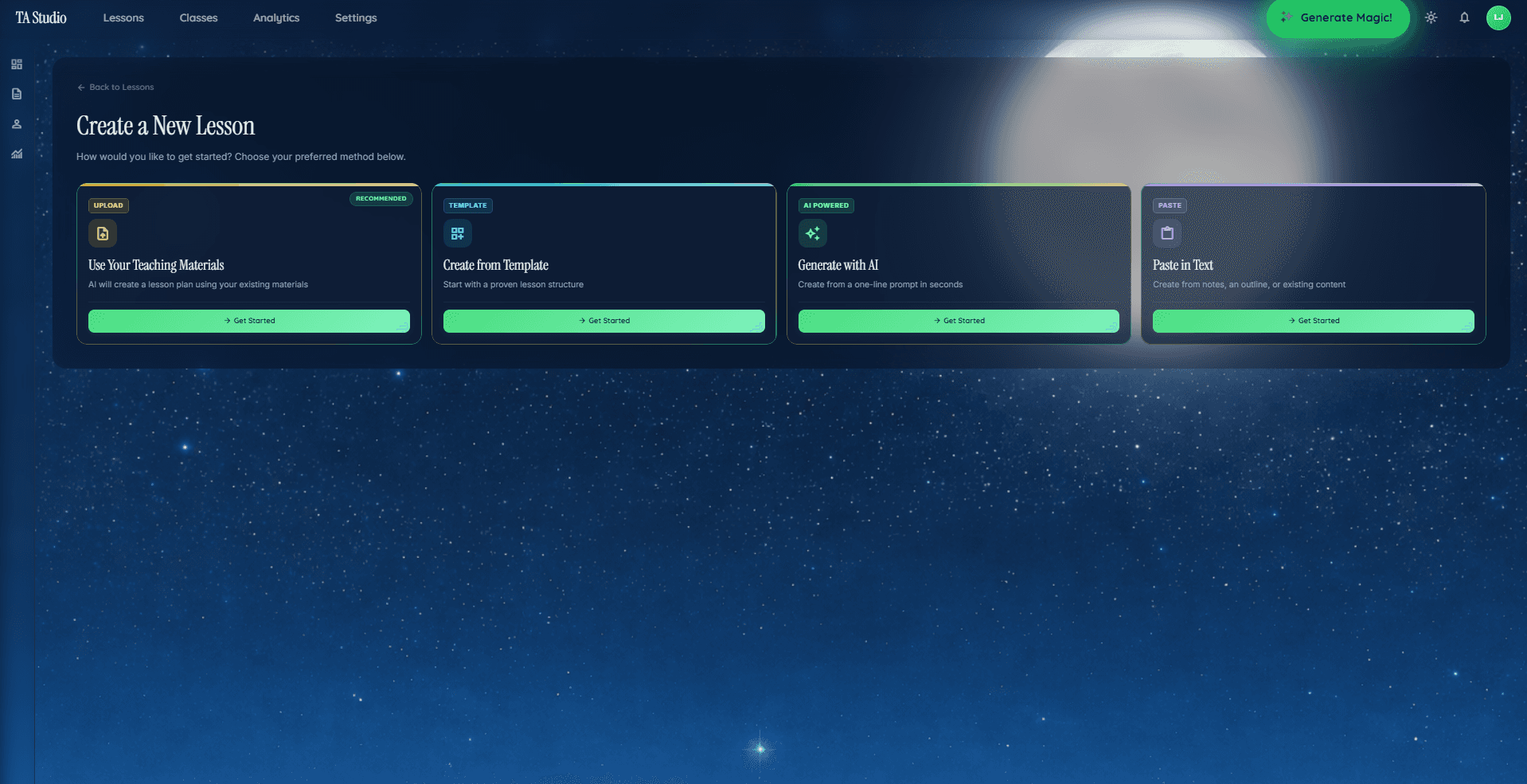
Every teacher knows the problem: you search "free lesson plan templates" and get either a blank box with labelled sections or a poorly scanned PDF from 2009. Neither saves meaningful time. What you actually need is a plan with a clear objective, a sequenced set of activities, and an exit ticket that tells you whether students got it — all calibrated to the grade you teach. To be clear upfront: these are lesson plans produced with AI assistance for any subject you teach, not lesson plans about AI as a topic.
That calibration matters more than most template libraries acknowledge. A lesson on fractions for Grade 3 looks nothing like one for Grade 7, even if the template structure is identical. The language, the time blocks, the prior knowledge assumed, and the assessment format all shift with the grade band. A K–2 lesson needs concrete manipulatives and three-minute activity chunks. A high-school lesson can sustain a twenty-minute independent task, expects students to handle abstract notation, and calls for a more formal exit assessment.
The 25 templates on this page are organized into four grade bands — K–2, Grades 3–5, Grades 6–8, and Grades 9–12 — with subjects chosen to cover literacy, numeracy, science, humanities, and specialist areas in each band. Every template names a specific research-backed teaching method, a single classroom-ready objective, and a link that opens the full generated plan in TAyumira's free lesson planner so you can edit it before your next class.
These are not blank frames. They are working lesson structures. If you want to go deeper on the methods behind them, see Best Free AI Lesson Planner for Teachers (2026) for a comparison of tools, or Retrieval Practice Lesson Plan: Template + 10 Classroom Examples for an in-depth look at one of the most evidence-backed approaches in this list.
How to use this page
Each template below gives you:
- The teaching method it is built on (one of ten research-backed approaches in TAyumira's pedagogy library).
- A single learning objective written in observable, classroom-ready language.
- A "Generate this plan free" link that pre-fills the topic in TAyumira's planner. Click it, confirm the grade and duration, and the tool produces the full plan — lesson phases, activity instructions, and exit ticket — in under a minute.
You can also open the free lesson planner directly and type any topic yourself. The templates here are starting points, not ceilings.
K–2 Templates
Grade band notes: lessons in this band work best in 20–35 minute blocks with concrete or sensory activity anchors. Objectives should target observable, single-skill outcomes. Assessment is almost always oral or gestural at this stage — a "thumbs up / side / down" or a brief class whiteboard share rather than written.
Template 1 — Phonics: Short Vowel Sound Discrimination
Grade: K–1 Method: Explicit instruction Objective: Students will be able to identify and distinguish the short /a/, /e/, and /i/ vowel sounds when heard in spoken CVC words.
This lesson follows a structured I-Do, We-Do, You-Do sequence. The teacher models sorting picture cards by vowel sound, the class sorts a shared set together, and students then sort an individual card deck. The exit ticket asks each student to say one new CVC word using the target vowel sound of the teacher's choice.
Template 2 — Early Numeracy: Counting On from Any Number
Grade: K–2 Method: Direct instruction Objective: Students will be able to count on from any given number between 1 and 20 using a number line or counting bears.
The teacher demonstrates counting on from 7 using a large floor number line, the class counts together from teacher-chosen start points, then students complete a partner activity using individual number lines. Exit ticket: the teacher calls a number aloud and each student holds up the number that is 3 more.
Template 3 — Science: Exploring the Five Senses
Grade: Year 1–2 Method: Inquiry-based Objective: Students will be able to describe at least three of the five senses by observing and recording what a mystery object looks, feels, sounds, and smells like before guessing what it is.
Students rotate through five sense stations in groups of three. At each station they record observations on a simple pictorial worksheet. The class reconvenes to share findings and agree on the mystery object. Exit ticket: each student draws one observation from the station they found most surprising.
Template 4 — Social Studies: Families and Communities
Grade: K–1 Method: Cooperative learning Objective: Students will be able to identify at least two ways their own family is similar to and two ways it is different from a partner's family by sharing and listening during a structured pair activity.
Paired students take turns sharing family photographs (or drawings) using a sentence frame: "In my family we ___." They record similarities and differences on a Venn diagram with teacher support. Class share-out closes the lesson. Exit ticket: students circle one similarity on a class anchor chart.
Template 5 — Art and Music: Shapes and Sound
Grade: Year 1–2 Method: Project-based Objective: Students will be able to create a simple percussion instrument using recycled materials and explain how the shape of the container affects the sound it produces.
Students are given a design brief: build an instrument that makes either a high sound or a low sound. They choose from a set of recycled containers, fill levels, and materials, then build and run a first test within the lesson. Each student plays their instrument for a partner and describes one design decision based on what they heard. A follow-up session, if time allows, can be used to refine the design and perform a four-beat pattern for the class. Exit ticket: an oral "one thing that worked and one thing I would change" reflection based on the first test.
Grades 3–5 Templates
Grade band notes: this band sustains 5–15 minute independent tasks and benefits from structured pair or small-group discussion. Written exits become practical. Objectives should be specific enough that students could self-check whether they met them.
Template 6 — Reading Comprehension: Main Idea and Supporting Details
Grade: Grade 3–4 Method: Explicit instruction Objective: Students will be able to identify the main idea and at least two supporting details in a non-fiction paragraph using a graphic organizer.
The teacher models with a short passage on a document camera, annotating the main idea in one colour and supporting details in another. Guided practice uses a second passage read aloud with think-alouds. Students then work independently on a third passage. Exit ticket: one-sentence written main idea.
Template 7 — Fractions: Understanding Halves and Quarters
Grade: Grade 3 Method: Direct instruction Objective: Students will be able to divide a whole shape into halves and quarters and shade a specified fraction correctly on three out of four drawn shapes.
Instruction begins with folding paper shapes to show equal parts, moves to drawing on whiteboards, and ends with a worksheet of four shapes to partition. The teacher circulates and corrects common errors (unequal parts) in real time. Exit ticket: students hold up their whiteboard showing one half of a rectangle.
Template 8 — Multiplication Fluency: The 6 and 7 Times Tables
Grade: Grade 4 Method: Retrieval practice Objective: Students will be able to recall all facts in the 6 and 7 times tables with no more than a 3-second delay by the end of a spaced low-stakes quiz sequence.
The lesson opens with a 3-minute silent retrieval quiz (paper, no calculator). The teacher reviews answers and students self-mark. A second retrieval round at the end of the lesson uses the same facts in a different order. Misconceptions from the first quiz are briefly re-taught between rounds using the "why does 6×7=42" pattern connection.
Template 9 — Simple Machines: Levers and Load
Grade: Grade 4–5 Method: Problem-based Objective: Students will be able to determine where to position the fulcrum on a lever to lift a 200g load using the least effort by testing at least three fulcrum positions and recording results in a data table.
Groups receive a metre ruler, a triangular fulcrum block, and standard weights. They predict, test, record, and explain the pattern. Each group presents their optimal fulcrum position and the reasoning behind it. Exit ticket: students write one sentence explaining why the fulcrum position changes the effort needed.
Template 10 — Geography: Reading Maps and Grid References
Grade: Grade 4–5 Method: Gamified Objective: Students will be able to locate a place on a grid-reference map and give the correct two-part grid reference for at least 5 of 6 locations on a classroom challenge map.
The lesson uses a "Treasure Hunt" frame: students navigate a custom classroom-scale map using grid references to find clues leading to a final answer. Individual challenge cards escalate in difficulty. Students who complete early become "navigators" and can hint (no telling) for struggling classmates. Exit ticket: students write the grid reference for one final location the teacher projects.
Template 11 — Writing: Narrative Opening Hooks
Grade: Grade 4–5 Method: Explicit instruction Objective: Students will be able to write an opening sentence that uses one of three hook techniques — action, dialogue, or surprising fact — and correctly identify which technique they used.
Three anchor text examples are read aloud and students vote on which hook technique each uses. The teacher writes a modelled hook on the board for a given scenario. Students draft their own hook for a prompt, swap with a partner to identify the technique used, and revise if the technique was unclear. Exit ticket: the draft hook sentence plus the technique label.
Template 12 — Elementary Coding: Sequencing Algorithms
Grade: Grade 5 Method: Inquiry-based Objective: Students will be able to write a correct three-step algorithm (sequence) in a block-coding environment that moves a sprite from the start position to the target position on a grid.
Students are given a grid puzzle and must figure out which block instructions move the sprite correctly. They test, observe errors, revise the sequence, and retest. Pairs compare their solutions and discuss whether different sequences can reach the same target. Exit ticket: students explain in one sentence why order matters in an algorithm.
Grades 6–8 Templates
Grade band notes: middle school lessons can sustain 15–20 minute independent phases and benefit from structured discussion protocols. Objectives at this level should be measurable enough for students to self-assess against them. Exit tickets can be written, digital, or discussion-based.
Template 13 — Algebra: Introduction to Variables and Expressions
Grade: Grade 6 Method: Direct instruction Objective: Students will be able to write an algebraic expression for a real-world situation involving one variable and evaluate that expression for two given values of the variable.
The teacher introduces variable notation with a concrete "mystery box" analogy, works three examples on the board with narrated reasoning, and then students complete four practice problems. A second tier of challenge problems is available for early finishers. Exit ticket: students translate one word problem into an expression and evaluate it for x=3.
Template 14 — Biology: Cell Structure and Function
Grade: Grade 7 Method: Retrieval practice Objective: Students will be able to name and state the function of at least six cell organelles from memory after a structured retrieval sequence using a blank cell diagram.
The lesson opens with a 5-minute retrieval quiz on a blank cell diagram. Students review their own responses against a model diagram projected by the teacher. Re-study time is provided for missed organelles. A second retrieval round at lesson close uses a different blank diagram orientation. The exit ticket asks students to name the one organelle they most expect to forget and explain its function.
Template 15 — History: Causes of World War I
Grade: Grade 8 Method: Cooperative learning Objective: Students will be able to explain at least two causes of World War I and connect each cause to a specific historical event by completing a group "causes web" poster.
Groups of four each receive one cause card (militarism, alliances, imperialism, nationalism, assassination). Each group researches their cause using provided sources, adds it to a shared class causes web, and presents their connection to the whole group. Exit ticket: students write one sentence explaining why a single assassination could trigger a world war.
Template 16 — Argumentative Writing: Structuring a Claim
Grade: Grade 7–8 Method: Explicit instruction Objective: Students will be able to write a claim statement and one piece of evidence with an explanation that logically connects the evidence to the claim, following the CEI (Claim–Evidence–Interpretation) framework.
The teacher deconstructs two model paragraphs on a document camera, colour-coding claim, evidence, and interpretation. Students then practice CEI with a provided data set on a low-stakes topic. Partner feedback uses a structured checklist. Exit ticket: one CEI paragraph on a teacher-assigned prompt.
Template 17 — Geometry: Area of Composite Shapes
Grade: Grade 7 Method: Problem-based Objective: Students will be able to calculate the area of an L-shaped composite figure by decomposing it into two rectangles and summing the areas, with correct unit labelling.
Students are given a scaled floor-plan of an irregular room and asked to figure out how much carpet is needed. They must decide how to decompose the shape, and multiple decomposition strategies are valid. Groups compare their decomposition method diagrams and confirm they reach the same total. Exit ticket: students calculate the area of a new composite shape and label the unit correctly.
Template 18 — Earth Science: The Rock Cycle
Grade: Grade 6–7 Method: Inquiry-based Objective: Students will be able to trace the path of one rock type through at least three stages of the rock cycle and explain what causes each transformation.
Working from unlabelled rock cycle diagram cards, student groups arrange the stages into a sequence that makes scientific sense, justify their ordering, and compare with another group. The teacher facilitates a class discussion to resolve disagreements. Exit ticket: students draw an arrow showing one pathway and label the process that causes the change (heat, pressure, erosion, cooling).
Template 19 — Foreign Language: Vocabulary Retention (Spanish, French, or German)
Grade: Grade 7–8 Method: Mastery Objective: Students will be able to produce the correct target-language word for 18 of 20 vocabulary items across two retrieval cycles, achieving a mastery threshold before moving to sentence-level use.
Students complete a 20-item retrieval test. Any item missed twice triggers a brief restudy loop with a spaced flashcard set. Students who reach the 18/20 threshold move to a sentence-construction extension. Assessment continues until mastery or end of lesson; no student moves on until they demonstrate mastery on the vocabulary set.
Grades 9–12 Templates
Grade band notes: secondary lessons can sustain extended independent work and expect students to manage their own time within structured phases. Objectives should be specific enough to appear on an assessment. Exit tickets at this level are often written and should prompt transfer or application.
Template 20 — Mathematics: Solving Quadratic Functions by Factoring
Grade: Grade 9–10 Method: Direct instruction Objective: Students will be able to solve a quadratic equation in standard form by factoring into two binomials and correctly identifying both roots for at least four of five practice problems.
The teacher works through the factor-pair method using a structured example set, narrating each decision point. Students work three guided problems alongside the teacher, then five independent problems. A stretch problem presents a quadratic with a leading coefficient greater than one. Exit ticket: solve x² + 5x + 6 = 0 by factoring and state both roots.
Template 21 — Biology: Photosynthesis — Light Reactions and the Calvin Cycle
Grade: Grade 10–11 Method: Flipped Objective: Students will be able to explain where in the chloroplast each stage of photosynthesis occurs and identify the inputs and outputs of the light reactions and the Calvin Cycle.
Pre-class: students watch a 12-minute annotated video on the two stages and complete a 5-question check-for-understanding form. In-class time is used entirely for a structured diagram-annotation task in pairs, a misconception-resolution discussion anchored to common wrong answers from the pre-class form, and an exit ticket requiring students to trace the fate of one water molecule through the full process.
Template 22 — Literature: Thematic Analysis of a Common Text
Grade: Grade 11 Method: Cooperative learning Objective: Students will be able to identify one major theme in a shared text, support it with two textual quotations, and explain the connection between each quotation and the theme in a structured group discussion.
Jigsaw structure: each group is assigned one chapter or section and extracts evidence for an assigned theme. Groups then re-form with one member from each original group, and each member teaches their evidence to the new group. The class constructs a shared theme-evidence chart. Exit ticket: one written paragraph making a thematic claim and citing one piece of evidence.
Template 23 — Chemistry: Stoichiometry — Mole Ratios
Grade: Grade 11–12 Method: Problem-based Objective: Students will be able to use a balanced chemical equation to determine the number of moles of product formed from a given number of moles of reactant in a single-step mole ratio calculation.
Students are given a "chemical manufacturing scenario" in which a company must determine yield before ordering raw materials. They work the mole ratio calculation for three reactions, compare answers in groups, and identify where rounding errors entered their work. The teacher targets two common errors (confusing coefficients with subscripts, skipping unit cancellation) in a whole-class debrief. Exit ticket: one mole ratio calculation under timed conditions.
Template 24 — Economics: Supply, Demand, and Market Equilibrium
Grade: Grade 10–11 Method: Gamified Objective: Students will be able to draw a supply and demand diagram, label the equilibrium price and quantity, and correctly predict the direction of price change when one curve shifts due to a stated event.
The lesson runs as a simulated marketplace. Students are assigned buyer and seller roles with private value/cost cards and negotiate trades until a natural market price emerges. The class then maps the trades onto a supply-demand diagram. The teacher introduces two "events" (a supply shock, then a demand spike) and students re-trade. Exit ticket: using their own trade records from the simulation, students identify which of the two shocks moved the traded price farthest from the original equilibrium and write one sentence explaining why, referencing the role they played.
Template 25 — Computer Science: Programming Fundamentals — Functions and Parameters
Grade: Grade 11–12 Method: Mastery Objective: Students will be able to write a function with at least one parameter that returns a calculated value, call the function with two different arguments, and explain in a comment what the function does.
Students work through a self-paced sequence: Level 1 (define a function with no parameters), Level 2 (add one parameter), Level 3 (add a return value and a second parameter), Level 4 (write a function from a plain-English description). Each level has an auto-checked test case. Students must pass the Level 3 test before attempting Level 4. The teacher circulates and provides targeted support. Exit ticket: a screenshot of passing test cases for the level reached.
How These Templates Were Generated
Every plan on this page was designed using TAyumira's pedagogy library — the same library available on the free tier of the free lesson planner.
The process for each template followed three steps. First, a teaching method was selected from the ten research-backed approaches in the library: explicit instruction, direct instruction, retrieval practice, inquiry-based, cooperative learning, problem-based, mastery, flipped, project-based, and gamified. Each method has a distinct lesson structure in the library — not a generic five-part template with the method's name attached, but a sequence of lesson phases specific to that approach. A retrieval practice lesson, for example, has two distinct retrieval rounds separated by re-study time; a cooperative learning lesson has a structured group assignment and a protocol for whole-class synthesis.
Second, an objective was written against the method's assessment logic. A retrieval practice lesson needs an objective that can be measured by accurate recall. A problem-based lesson needs an objective tied to the solution or explanation the group produces. This alignment between method and objective is what makes a plan teachable rather than just formatted.
Third, activities and exit tickets were designed to be feasible within standard lesson durations for the grade band. The K–2 templates assume 25–30 minute lessons. The secondary templates assume 45–60 minutes. If your lesson time differs, opening the plan in TAyumira and adjusting the duration field will redistribute the phase timings automatically.
All 25 templates are editable. You are not locked into the generated output. Teachers using TAyumira regularly adjust the hook activity, swap in a local context example, or extend the exit ticket for a higher-ability group. The pedagogy structure is preserved across edits.
Which Method to Pick
If you are not sure which teaching method fits a lesson, this decision framework covers the most common situations.
| Situation | Method to use |
|---|---|
| Introducing a completely new concept with no prior knowledge | Explicit instruction or direct instruction |
| Students have seen the concept before and need to strengthen recall | Retrieval practice |
| Students need to discover a pattern or form a hypothesis | Inquiry-based |
| The lesson centres on a real-world problem or scenario | Problem-based |
| Building collaboration and communication alongside content | Cooperative learning |
| Students are at different starting points and need individual pacing | Mastery |
| Core instruction happens outside class time and class time is for application | Flipped |
| Motivating a reluctant class or making repetitive practice engaging | Gamified |
| Building a multi-session artefact — a report, model, or product | Project-based |
For a deeper explanation of retrieval practice, see Retrieval Practice Lesson Plan: Template + 10 Classroom Examples. For explicit instruction, see Explicit Instruction: Step-by-Step Guide + Lesson Plan Examples. The free tier of TAyumira includes all ten methods, so there is no reason to limit yourself to one approach.
Start Using the Templates
The fastest way to turn any template above into a ready-to-teach lesson is to click the "Generate this plan free" link. It opens the planner with the topic pre-filled. Select your grade level and lesson duration, and the full plan is generated in under a minute — complete with lesson phases, activity instructions, materials list, and an exit ticket.
If you would rather start from scratch, open the free lesson planner directly. You get the full pedagogy library on the free plan, no credit card required, and no limit on how many plans you save.