The Year My Best Teaching Friend Stopped Smiling
Watching a colleague burn out is one of the hardest experiences in teaching. The signs you'll see, what to say, what not to say, and how to actually help.
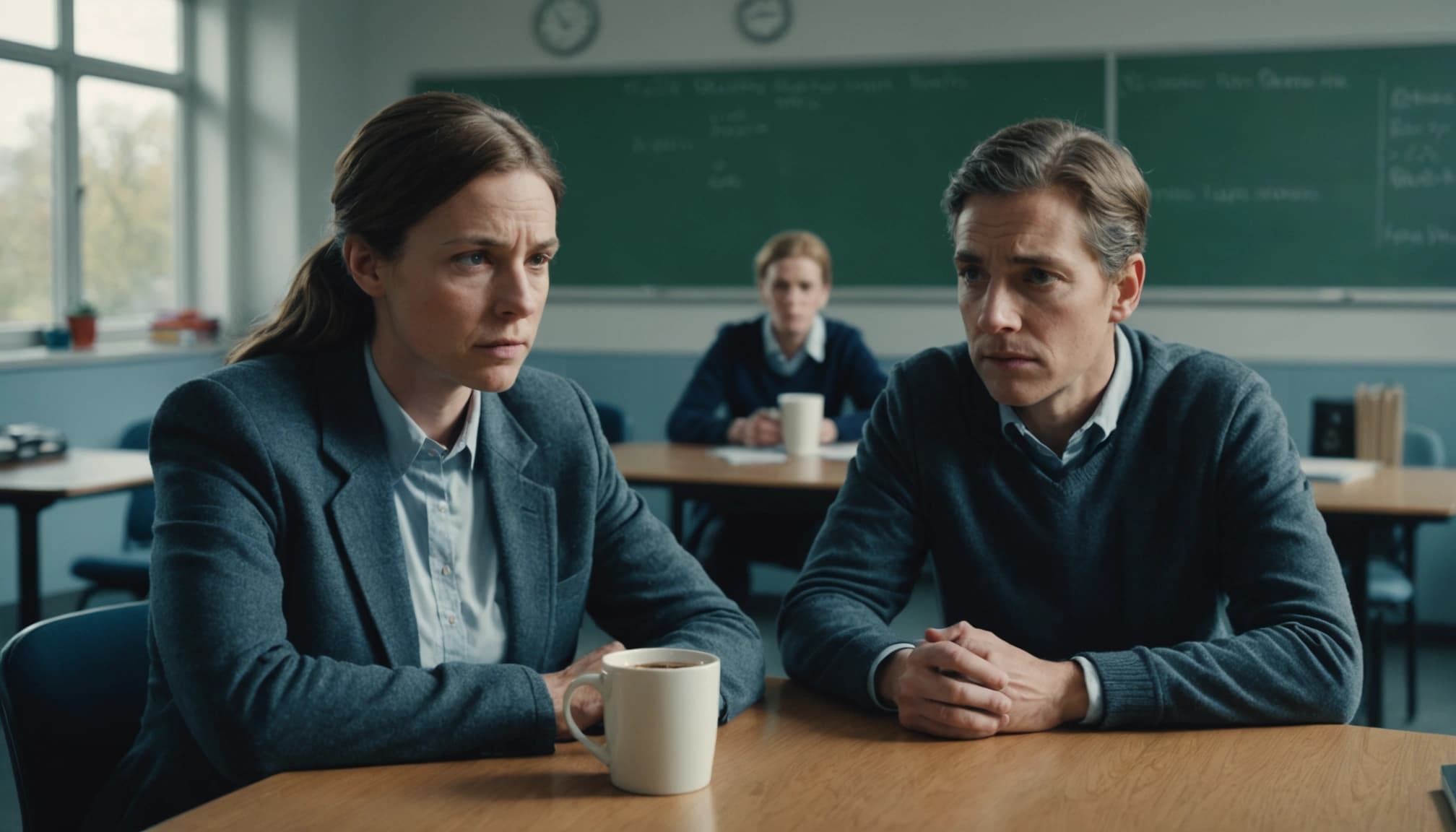
The strange thing about watching a colleague burn out is that you almost always see it before they do. You see the smile that doesn't quite reach the eyes. The break-time conversations that get shorter. The way they stop telling you about their classes — not in a deliberate way, just in a fading way, the way a radio signal fades when you drive too far from a city. By the time they admit anything is wrong, you've been quietly carrying the knowledge for months.
This post is for the teacher who is watching it happen to someone they care about and doesn't know what to do. The friend in the next classroom. The colleague who used to be the funniest person in the staffroom and now barely finishes sentences. The mentor who taught you the job and is now visibly disappearing into it. This is what I've learned from watching the version of this story that played out next to me — what the warning signs actually looked like in retrospect, what helped, what made it worse, and what I wish I had done sooner.
The signs you will see (in the order you usually see them)
Watching a teacher burn out is rarely a sudden event. It is a slow tilting of small markers, most of which look explainable individually. Stacked together, they tell a clearer story.
1. The morning energy disappears first
The first thing to go is the morning. Teachers who used to arrive cheerful and chatty start arriving silent. They get to their classroom early and shut the door. They don't come into the staffroom for tea. They are at school — they are just no longer with the school. Most of us miss this stage entirely because we are busy with our own mornings.
2. Lunchtimes get smaller
The second sign is the eating. They start having lunch at their desk instead of in the staffroom. Then they start skipping lunch entirely, or eating something thin and non-nourishing — a piece of fruit, half a cereal bar, the same protein bar they had yesterday. The shrinking lunch is rarely about food. It is about not having the energy to be sociable, plus a dropped appetite from chronic stress.
3. The conversation topics narrow
Where they used to talk about their weekends, their families, their hobbies, their plans, the conversation shrinks to a single channel: the school. Specific classes. Specific students. The marking pile. The accountability paperwork. The friend who used to talk about their kid's football match, their partner's job, the box set they were watching, slowly only talks about work — and only the heavy parts of work.
4. The cynicism arrives
You'll hear it as small comments at first. Of course they think we'll do that. Of course leadership doesn't care. Cynicism is one of the three formal symptoms of clinical burnout (the others being exhaustion and reduced efficacy — see The Inevitable Toll of Teacher Burnout). When a previously warm colleague starts making cold jokes about the job, the job has already started winning.
5. The body changes
By this point you'll notice physical signs. Weight changes. Recurrent illness — they are always coming back from a cold or a stomach bug. Tension in the jaw. They look tired in a way that sleep doesn't fix. Many of them stop wearing the things they used to wear with care — the watches, the shoes, the fitted shirts — and shift to the same plain comfortable clothes every day. This is a quiet retreat from the version of themselves they used to be.
6. The work falters in small ways
The lesson that used to be planned is improvised. The marking that used to be returned in three days takes ten. The form that used to be in by Friday is in by Monday. They are still doing the job — but only just, and only the visible parts. The discretionary, generous parts of the role have quietly stopped.
7. They tell you, in a sentence
This is the hardest moment. They will tell you, but rarely directly. Usually it is a sentence like "I don't know how much longer I can do this" dropped into an unrelated conversation, then immediately walked back. "Sorry — bad day, ignore me." Most colleagues do ignore it. The teachers I know who stayed in the profession longest are the ones who, when they heard that sentence, didn't ignore it.
What to say (and what to leave unsaid)
There is a particular kind of advice teachers give each other that is well-intentioned and almost never helps. It is the take care of yourself and make sure you're getting your steps in kind. It comes from a real place. It does not work on a person who is structurally exhausted.
What does work, in my experience, is short, specific, and unromantic. Three things.
Name what you've seen, without diagnosing. "I've noticed you've been quieter for a few weeks. Is everything okay?" This is the most useful single sentence you can offer. It does not pathologise. It does not assume burnout. It just creates a small opening. They might decline to walk through it. They might walk through it later. Either way, you have signalled that you've noticed, and the friend who notices is statistically the friend a burned-out teacher confides in.
Offer one specific concrete thing, not a general willingness to help. "I'm doing the maths planning for Year 4 this weekend — let me copy you in" is more useful than "let me know if you need anything." Burned-out people don't have the cognitive capacity to identify what they need or to ask. Bring them a specific fish, not a fishing rod.
Don't give advice unless they ask. This is the one I learned the hard way. Suggesting they "just go to the GP" or "set boundaries with leadership" or "consider a different school" lands as another item on a to-do list they already cannot face. Hold the advice. Sit with the conversation. Let them think aloud. Most of the breakthroughs come from them, not from you.
What to leave unsaid:
- "You used to be so much more energetic." True, but cruel.
- "You should really talk to [SLT member]." They've tried, or they know it won't help.
- "Have you tried meditation?" Suggest this once if you genuinely think it'll help. Don't repeat it.
- "Maybe teaching just isn't for you anymore." This may be true, but it is not your call to make and not your sentence to deliver.
What actually helped — concretely, in the version of this I lived
In the case of my own teaching friend, three things ended up moving the needle. None of them were dramatic.
Friday tea. We started having a proper cup of tea after school every Friday. Not in the staffroom — at a quiet café two streets from school. Twenty minutes, no agenda, no advice. The repeated, low-pressure presence of a friend who wasn't trying to fix anything turned out to be one of the structural changes my friend later credited with stopping the slide.
Sharing the planning. I started sharing my Year 4 maths and English plans, even though we taught different classes — same year group, different sets. They could adapt or use whole-cloth, no expectation of reciprocation. This stripped maybe two evenings a week off the workload, which is what they needed to start sleeping again.
Helping them frame the conversation with leadership. When the structural conversation with their head of department finally happened, we had spent two evenings beforehand framing it. Not I am exhausted (which is read as a wellbeing problem owned by them) but here are three specific structural elements of my workload that are unsustainable, and here is what I propose changes. The framing got more results in one meeting than they had got in two terms of vague disclosures.
For more on what burned-out teachers actually need at the structural level rather than the wellbeing level, see The Inevitable Toll of Teacher Burnout.
What you should also know about the limits of being a friend
Even with all of this, you cannot save a colleague from burnout. You can only soften it. Burnout is structural — a feature of the job's demands outrunning its supports — and individual friendship cannot replace structural change.
Sometimes your friend will leave the profession. That is sometimes the right outcome. Some teachers should leave; some should change schools; some should find a sideways move into instructional coaching, ITT, examining, or EdTech. Treating the option of leaving as a legitimate professional outcome rather than a failure (see The Resignation Letter I Wrote and Never Sent) is itself a kindness.
Sometimes your friend will recover in role and stay. The friend whose smile I watched disappear came back. It took most of a year. The smile is different now — quieter, more guarded, less generous than the original. But it is back. And we still have Friday tea.
What I wish I had done six months earlier
The honest answer to what I wish I had done is: I wish I had said the first sentence — "I've noticed you've been quieter for a few weeks" — six months sooner than I did. I noticed in October. I said something in April. The intervening six months were the worst of my friend's career and the worst of their relationship and the worst of their health, and I had been watching it happen the whole time, telling myself I didn't want to intrude.
I should have intruded. Most colleagues should intrude. Burned-out teachers don't experience the noticing as intrusion. They experience it as relief.
If you are reading this with a colleague in mind, the small action this week is to find five minutes for the first sentence. "Hey — I've noticed you've been quieter for a few weeks. Is everything okay?" You don't need a follow-up plan. You don't need to fix anything. You just need to ask once, and then listen if they answer.
Most of them will say I'm fine the first time. Ask again next week. Eventually one of them will tell you the truth, and the noticing will be the thing that started their recovery — not the advice you gave, just the fact that you saw them.
FAQ: helping a burned-out teacher colleague
How can I tell if my teacher friend is burned out or just having a bad week? The pattern is duration. A bad week resolves with a weekend or a half-term. Burnout is structural — the symptoms persist across recovery points. If your colleague returns from October half-term still flat, still cynical, and still not eating in the staffroom, that is not a bad week.
What's the single most useful thing I can do? Name what you've seen without diagnosing. "I've noticed you've been quieter for a few weeks — is everything okay?" That sentence creates the opening. The rest follows from there.
Should I tell my line manager I'm worried about a colleague? Only with the colleague's knowledge or consent, except in cases of safeguarding concern. Going over their head feels protective but typically damages trust. The exception is genuine concern about their safety — in which case follow your school's safeguarding procedure.
Will my burned-out friend recover if they stay in teaching? Sometimes yes, with structural workload reduction (school change, role change, AI-supported planning, reduced timetable). Sometimes the recovery requires leaving. Both are legitimate outcomes. The friend's job is not to lobby for either — just to be present.
Can compressing lesson planning help my friend? Indirectly, yes. The lesson-planning layer is one of the largest reducible costs in the role. Sharing your plans, recommending a pedagogy-aware AI tool like TAyumira's free planner, or simply offering to do the slides for one of their lessons can give back the cognitive bandwidth they need to start recovering.
If you're looking for a way to lighten a colleague's evening workload, TAyumira's free lesson planner builds a complete, evidence-informed lesson plan with slides and an exit ticket in minutes. Pedagogy-aware. No card. The point isn't the tool — it's giving someone back 30 minutes of their evening when they need it.